Can an AI get better at science by studying its own lab notebook?
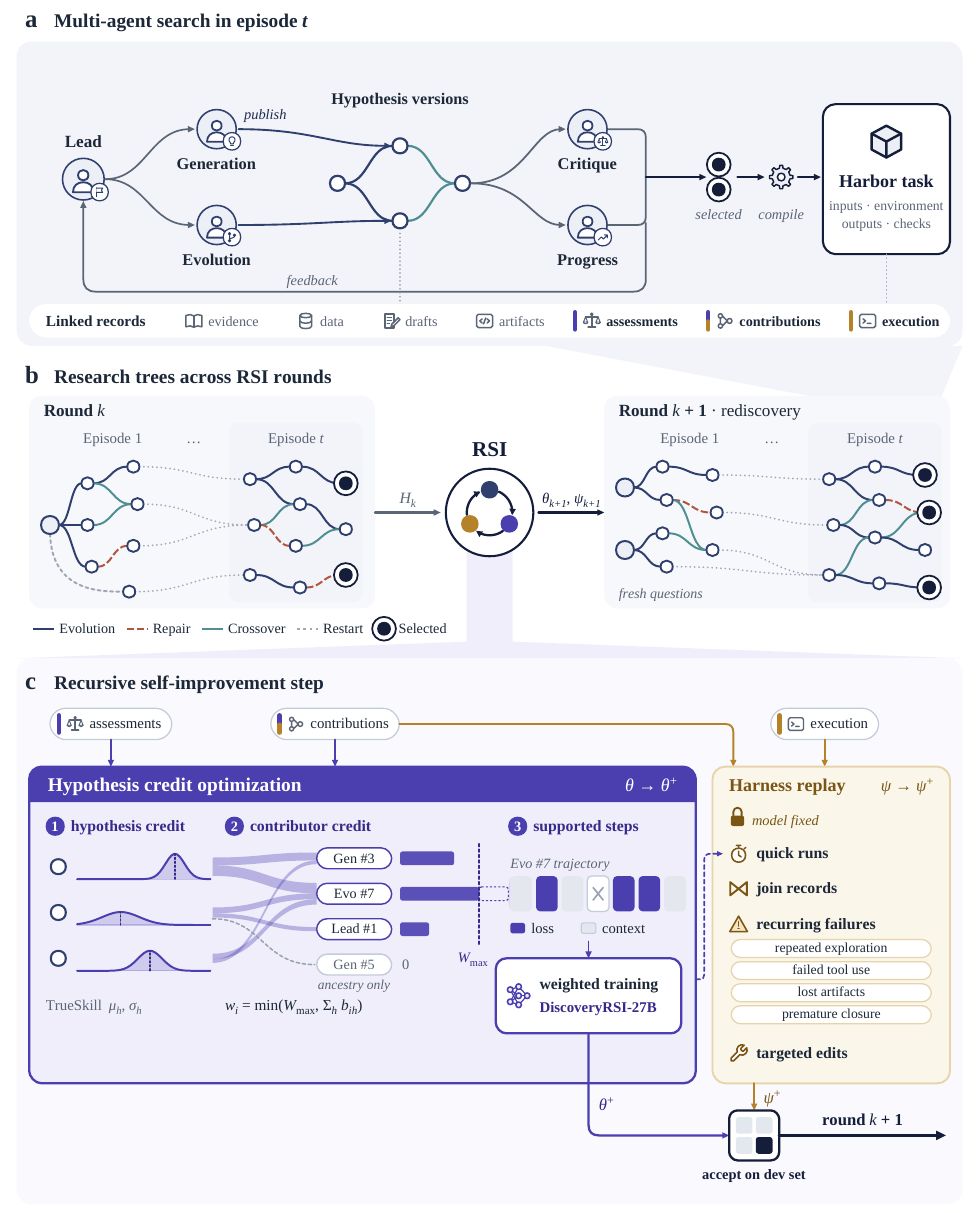
In my opinion, automating scientific discovery is probably one of the most exciting frontiers in AI right now.
The goal is to automate the very engine of human progress: form hypotheses, test them, and build knowledge on top of the results. But it’s proving harder than many of us expected.
A new paper, “DiscoveryRSI: Recursively Learning to Discover Valuable Hypotheses” (Zhong et al., arXiv, 20 October 2026), proposes a team of AI agents that develops research hypotheses, records who contributed what, and retrains itself on the steps that worked.
The authors report that hypothesis quality rises from 4.86 to 5.39 (on a 1–10 scale) after two rounds of self-improvement. They also report that 6.3% of its hypotheses connect to research published after the model’s training cutoff, against 2.5% for GPT-6 and 2.3% for Claude Opus 5.
It’s a thoughtful, well-documented piece of work, and the results sound promising.
However, I’d take them with a pinch of salt:
🔹 Matching later papers is a weak proxy for value. IMHO, it rewards ideas the field was already heading towards, while a truly original idea would score as a miss.
🔹 AI grading AI. The quality scores come from a GPT model, and the “three reviewers” are prompts to the same model family.
🔹 Better plans, but not necessarily better ideas. The gains are in falsifiability and study design, while importance and novelty actually declined. And none of the hypotheses was actually run as an experiment.
The challenge remains open, and it’s still one of the most fascinating ones around 💪
Originally posted on LinkedIn.